Projects
This page gives an overview of some of my ongoing projects.
New software for aqueous fluid calculations
Aqueous fluids are found throughout Earth, including in the mantle and magmatic systems. While we have developed a quantitative understanding of their properties and chemical reactions throughout the crust and upper mantle, our thermodynamic treatment and its applications are limited by the software required to solve the speciation problem. I am developing an extension to the ENKI ThermoEngine Coder module to enable development of new models for speciated fluids, and the accompanying architecture necessary for incorporating them into generalised mass-transfer calculations. At the 2026 Goldschmidt meeting in Montreal, I presented an update on this work, and hope to release a version of this in early 2027.
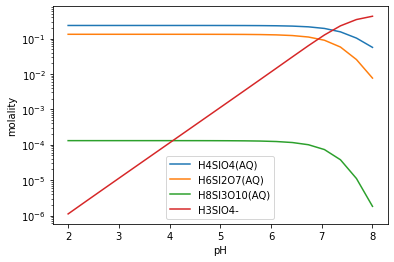
The pyDEW software was an early version of this. While it enabled an extension of the MELTS model to magmatic brines, it relied on using legacy software. A new version of pyDEW will be released using the new software developed on the ENKI platform. DEW is the Deep Earth Water model, created by Dimitri Sverjensky.
Insights into magmatic processes from active volcanic systems
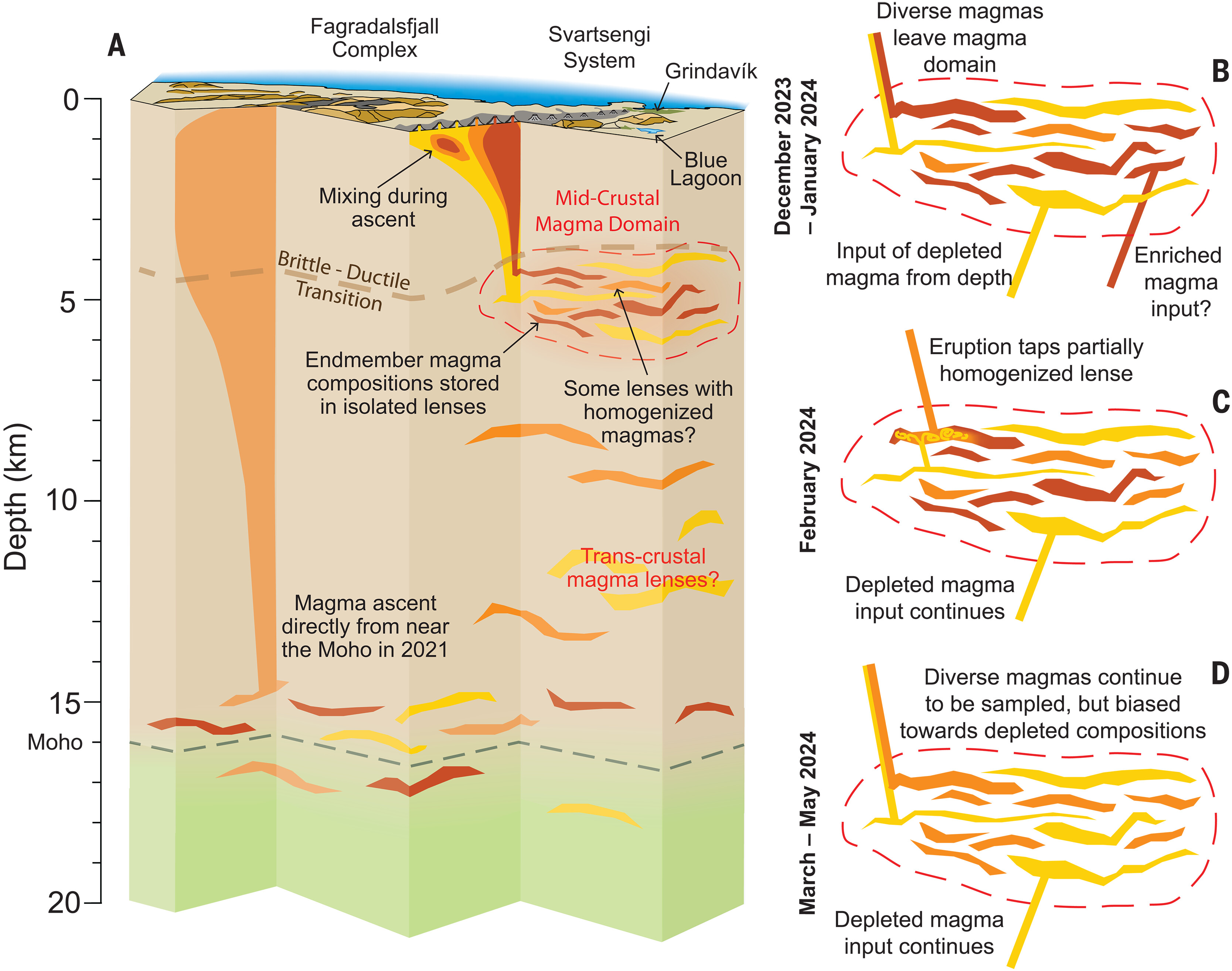
Renewed volcanic activity on Iceland’s Reykjanes peninsula has provided us with a unique opportunity to link high resolution petrographic and geochemical observations with eruptive processes and geophysical observations. Alongside others at the University of Iceland, we have been collecting extensive sample sets, and using their geochemistry to gain new insights into the operation of both the magmatic systems on Reykjanes, but also magmatic systems in general. You can read about our work on Svartsengi at Science.
Thermodynamic modelling of Icelandic magmatic systems
I am working to improve our ability to accurately (and predictively) model the evolution of magmas and their fluids for compositions and conditions relevant for Icelandic magmatic systems. This includes improving models for mantle melting, as well as for simulating magmatic fluids. I am actively seeking funding to further this project.
Novel stable isotopes in modern and ancient magmatic systems
Novel stable isotopes (of e.g. Fe, Ni, Mg) can record information about a magma’s source and its formation processes. I am interested in both modelling these systems, but also creating new datasets. At the University of Iceland I am working to set up the Ni stable isotope system.
Quantitative Petrography
Inspired by the wealth of information recorded in the samples we have obtained from the recent eruptions on Reykjanes, I am working to set up protocols for rapidly acquiring quantitative petrographic data from rock samples.